How to Load Fly Line on a Reel: Step-by-Step Guide

Affiliate disclosure: Some links on this page are affiliate links. If you buy through them we earn a small commission at no extra cost to you. Recommendations are research-driven; we don't claim personal use of every product reviewed. Product prices and availability are accurate as of the date published and are subject to change. Always check Amazon for current pricing before purchasing. Learn more.
Quick Picks
(1/2WT 3/4WT 5/6WT 7/8WT) Fly Reel with Line Combo Aluminum Alloy Large Arbor Fly Fishing Reels Weight Forward Fly Line with Braided Backing Taper Leader Pre-Tied
Buy on AmazonFly Fishing Reel Fly Reels - Large Arbor CNC-Machined Aluminum Alloy Body Light Weight 5/7, 7/9, 9/10 wt (Black, Green, Silver/Blue, Gray-Green, Silver-Blue,Gunmetal,Ice Blue,Sapphire Blue)
Buy on AmazonSF SF-003 Pro Fly Fishing Reel for Freshwater,CNC Precision Machining Process,Mid Arbor Design,Smooth Drag System,Lightweight Aluminum Body
Buy on Amazon| Product | Price Range | Top Strength | Key Weakness | Buy |
|---|---|---|---|---|
| (1/2WT 3/4WT 5/6WT 7/8WT) Fly Reel with Line Combo Aluminum Alloy Large Arbor Fly Fishing Reels Weight Forward Fly Line with Braided Backing Taper Leader Pre-Tied also consider | $$ | Buy on Amazon | ||
| Fly Fishing Reel Fly Reels - Large Arbor CNC-Machined Aluminum Alloy Body Light Weight 5/7, 7/9, 9/10 wt (Black, Green, Silver/Blue, Gray-Green, Silver-Blue,Gunmetal,Ice Blue,Sapphire Blue) also consider | $$ | Buy on Amazon | ||
| SF SF-003 Pro Fly Fishing Reel for Freshwater,CNC Precision Machining Process,Mid Arbor Design,Smooth Drag System,Lightweight Aluminum Body also consider | $$ | Buy on Amazon |
Loading fly line on a reel correctly is one of those foundational skills that gets glossed over in beginner guides, then quietly blamed for casting problems nobody can explain. Backing capacity, arbor size, line direction, connection knots, each step affects how your system performs on the water. Get it wrong and you deal with memory coils, poor drag function, and line that piles up unevenly on retrieve.
The process is the same whether you fish a tailwater like Cheesman Canyon or a freestone stretch of the Arkansas. What changes is which line you load and why. For a deeper look at how line choice affects presentation, the Lines, Leaders & Tippet hub covers taper profiles, leader formulas, and tippet selection in full detail.
Why the Setup Sequence Actually Matters
Most anglers load their first reel the way someone showed them once, then repeat that process forever without questioning it. A few common habits, like skipping backing, loading line off the spool without controlling twist, or guessing at arbor direction, create problems that show up weeks later on the water and get misattributed to casting form.
The setup sequence has a logic to it. Backing fills the arbor so your fly line sits at a larger diameter, which means faster retrieval per handle revolution and less coiling from memory. The fly line loads on top of that, and because it’s tapered, it has a correct direction: the thick belly toward the reel, the thin running line toward the rod tip. Reverse that and your loop turnover degrades. Small mechanical decisions made at the vise compound downstream.
Line type changes the picture further. A standard weight-forward floater loads differently than a Euro nymph line. I run the Cortland Competition Nymph setup on my 10’6” 3wt, and that system uses a level monofilament core with no traditional fly line weight at all. There’s no belly to track, no taper direction to worry about in the same way, but backing capacity and spool tension still matter. The system is designed as a unit, and every component of the load affects how the sighter behaves under tension.
On my tailwater rigs, presentation drives every line decision. After years of fishing a standard WF5F at Cheesman Canyon, I couldn’t figure out why I was spooking fish on long flat glides that other anglers were catching fish on. A guide finally watched my cast and identified the problem: the heavy front taper of my WF line was hitting the water with a noticeable slap on final turnover. Switching to a double-taper eventually fixed it. On technical, pressured water, presentation wins over casting distance every time, and how you load your reel is the first step in building a system that supports your presentation goals.
How to Load Fly Line on a Reel: Step by Step
Step 1: Determine Arbor Direction and Reel Orientation
Before any line touches the reel, figure out which hand retrieves. Most reels ship configured for right-hand retrieve and can be converted. Converting usually involves pulling the spool, flipping the drag insert or pawl, and reseating. Check the manufacturer instructions, the process differs between click-pawl designs like my Hardy Marquis and sealed drag systems.
Once you’ve set retrieve hand, determine the direction your backing should wind. The rule: line should come off the bottom of the spool on the rod-side. Backing that loads from the top creates slack loops and uneven layering. This is a small thing that most beginners skip, and it matters more on large-arbor designs where spool speed changes significantly between full and empty.
Step 2: Attach Backing to the Spool
Dacron backing in 20 lb for trout setups, 30 lb for heavier work. Use an arbor knot: loop the backing around the spool arbor, tie an overhand knot around the standing line, tie a second overhand knot at the tag end to act as a stop, pull the first knot tight against the spool. It’s not a glamorous connection but it holds. Some anglers use a Uni knot here, which also works.
Wind backing under moderate tension by running it through the fingers of your non-dominant hand. Even tension layering from the start prevents the accordion effect where soft-wound inner layers collapse under a big fish’s first run. On reels with a click drag, you can engage the drag lightly to create resistance as you wind.
Fill to the appropriate level. Most trout reels need 50-100 yards of backing under a standard WF or DT line to bring the loaded spool to proper capacity. Check the reel manufacturer’s specs for your line weight and arbor size.
Step 3: Connect Backing to Fly Line
The standard connection is an Albright knot or a loop-to-loop if your fly line has a welded loop at the running end. Most quality modern fly lines come with factory welded loops. Loop-to-loop is faster and allows quick line swaps, but the connection should be checked periodically because the welded loop can crack on lines that have seen a lot of heat or UV exposure.
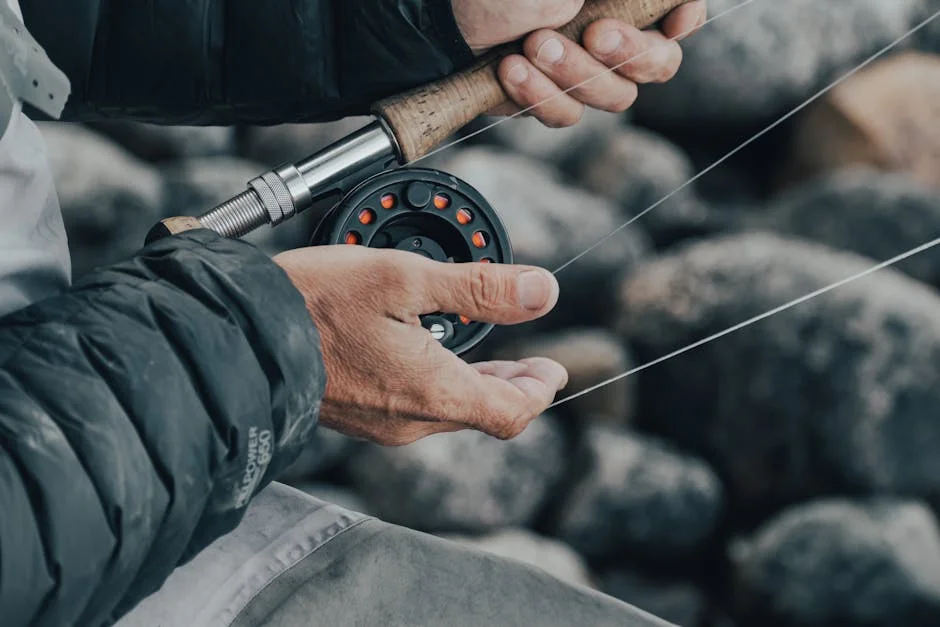
If there’s no welded loop, use an Albright: run the backing through the loop of fly line material, wrap ten to twelve turns back down the doubled section, pass the tag end back through the original opening, pull tight, trim close. It’s a compact knot that passes through the guides without hanging.
Step 4: Load the Fly Line
Here’s where most people introduce twist. If you pull fly line off a spool that’s sitting flat on a table, the line rotates and loads twist into the system. Instead: run a pencil or pen through the spool center and have someone hold it horizontally, allowing the spool to spin freely as you wind. Line comes off the side of a spinning spool without adding twist.
Weight-forward lines have a thick belly section and a thin running line. The running line (thinner end) attaches to the backing. The leader attaches to the front taper (thicker end that transitions to the tip). If your line doesn’t have clear labeling, unroll a few feet and feel both ends, the running line end is noticeably thinner.
Load under light tension using the same finger-guide method as backing. Even layering matters on the fly line too. Most fly lines run 90 feet of shootable head plus running line. On a properly sized reel, the fly line should fill the spool to within about an eighth of an inch of the rim.
Step 5: Attach Leader and Tippet
Standard connection at the fly line tip is loop-to-loop to a factory or hand-tied leader loop. If your fly line doesn’t have a welded loop at the tip, you can add one with a whip finish over a folded section, or simply nail-knot a leader butt directly to the fly line. The nail knot is more streamlined through guides.
Leader formula depends entirely on what you’re fishing. On the South Platte in low clear water, I run 12-foot leaders to 6X for dries. On the Arkansas in faster pocket water, a 9-foot leader to 4X or 5X handles most of my euro and dry fly situations. The leader is part of the system, not an afterthought.
Top Picks for Reel and Line Combos
If you’re starting fresh or setting up a second rod, mid-range combo options have gotten noticeably better in the last few years. CNC-machined aluminum reels that were once premium-tier prices have come down to a range where they make sense for most trout anglers. Here are three worth considering at the mid-range level.
(1/2WT 3/4WT 5/6WT 7/8WT) Fly Reel with Line Combo Aluminum Alloy Large Arbor
The 1/2WT 3/4WT 5/6WT 7/8WT Fly Reel with Line Combo packages a large-arbor aluminum reel with a weight-forward fly line, braided backing, and a tapered leader with a pre-tied loop. Spec data shows the combo comes sized across the common trout and light saltwater weight classes, which makes it functional for anglers setting up a first system or a dedicated nymphing rod without sourcing components separately.
Verified buyers note that the pre-spooled configuration saves real time, especially for anglers who aren’t yet comfortable with the backing and line loading sequence outlined above. Owner reviews mention that the included WF line performs adequately for general trout fishing, though anglers fishing technical tailwater may eventually want to swap it for a presentation-specific taper. The large-arbor design is a genuine advantage here: faster retrieve rate and reduced line memory compared to standard-arbor alternatives.
Field reports from owner communities suggest the drag system is functional for trout and light freshwater use, though it’s not in the same category as machined-stack or sealed drag systems on premium reels. For someone learning the system, setting up a backup rod, or fishing freestone water where presentation tolerances are more forgiving, that’s a reasonable tradeoff at the mid-range price band. The included backing, line, and pre-tied leader means this setup is ready to fish with minimal additional work.
Check current price on Amazon.
Fly Fishing Reel Large Arbor CNC-Machined Aluminum Alloy Body (5/7, 7/9, 9/10 wt)
The Fly Fishing Reel Large Arbor CNC-Machined Aluminum Alloy Body covers the heavier end of the freshwater and light saltwater spectrum, offered in 5/7, 7/9, and 9/10 weight configurations with a range of finish options. Spec data confirms CNC machining on the body, which matters for frame rigidity and drag seat precision, features that become more relevant when fighting larger fish on heavier tippet.
Owner reviews highlight the finish quality and arbor size as standout characteristics at this price band. Verified buyers report that the drag adjusts smoothly across its range, which is useful for anglers calibrating a new reel before loading. For larger-water trout fishing, streamer work on the Arkansas or Missouri, or transitioning into bass and carp applications, the 5/7 size hits a useful middle ground. The 7/9 and 9/10 configurations extend the reel into pike, redfish, and bonefish territory.
Field reports indicate the reel loads and retrieves line smoothly, with the large arbor delivering the faster pickup rate that matters when a fish runs toward you on a flat. If you’re setting up a dedicated streamer rod alongside a 5wt dry fly rod, this reel in the 5/7 configuration represents a step up in capability from a standard small-arbor design without moving into premium pricing.
Check current price on Amazon.
SF SF-003 Pro Fly Fishing Reel for Freshwater
The SF SF-003 Pro Fly Fishing Reel is a mid-arbor design, a configuration that splits the difference between the fast retrieve of large-arbor reels and the compact footprint of traditional arbor designs. Spec data shows CNC precision machining on the aluminum body, a smooth drag system, and a lightweight build, all characteristics that show up consistently in the mid-range tier.
Verified buyers note that the drag engages consistently without the stutter that occasionally appears in entry-level disc drag designs, and owner reviews describe the reel as noticeably light in hand. For anglers doing a lot of walking and wading, weight accumulates across a long day and a lighter reel makes a difference on reach-heavy stretches. Field reports from freshwater users on trout and panfish applications are generally positive, with the drag performance cited as the primary selling point relative to the price band.
The mid-arbor geometry does mean a slightly slower retrieve rate compared to large-arbor designs, which is worth considering if you’re fishing water where you need to pick up line fast during a fish’s run toward you. For most creek and river trout fishing, including euro nymph setups where you’re rarely deep into the backing, mid-arbor is a practical choice that balances retrieve rate and line-coil management without the full-diameter bulk of a large-arbor spool.
Check current price on Amazon.
Buying Guide: What to Consider Before You Load
Matching Reel Capacity to Line Weight
The first job of any reel is to hold the right amount of backing and fly line without overfilling or sitting mostly empty. Manufacturers publish backing capacity specs for a reason: a reel rated for 75 yards of 20 lb Dacron under a WF5F will perform differently from the same reel stuffed with 30 lb backing. Overfill and the line piles against the frame on retrieve. Underfill and your arbor diameter drops, slowing retrieve rate and increasing line memory.
Most trout fishing in the 3-6 weight range doesn’t require more than 50-75 yards of backing. You’re unlikely to see a rainbow strip you past 100 feet of fly line on most Colorado freestone water. The exception is larger fish on tailwaters or true trophy water where a big brown might run 80 yards. Err toward slightly more backing capacity than you think you need, especially on larger rivers.
Drag System Type and Calibration
Fly reel drags fall into a few basic categories: click-pawl, disc drag with cork or synthetic stacks, and sealed drag systems. For most freshwater trout fishing, a basic disc drag with a smooth adjustment range is sufficient. What matters is consistency: a drag that varies in pressure depending on spool position, or one that doesn’t hold its setting between trips, introduces unpredictability when a fish runs.
Calibrate your drag before loading a new reel by holding the fly line in one hand and pulling while adjusting the knob. Set it light enough that a fish can take line without breaking tippet, but with enough resistance to feel it working. Most trout situations call for a drag set well below the breaking strength of your tippet. For 6X tippet, that’s a very light setting. The Lines, Leaders & Tippet hub has detail on tippet strength charts that help you calibrate drag to your leader’s actual breaking point.
Large Arbor vs. Mid Arbor for Line Management
Large-arbor reels dominate the current market for good reason: faster retrieve per revolution, less line memory from tight coiling, and more consistent drag pressure because spool diameter stays relatively constant as line is stripped out. For most trout fishing, these are genuine advantages, not marketing claims.
Mid-arbor designs are worth considering for anglers prioritizing compact profile or fishing applications where the retrieve speed difference isn’t significant. Creek fishing with an 8’6” 4wt, for instance, where fish rarely run more than 20 feet, is a situation where arbor size matters less than overall reel weight and balance on the rod.
Understanding What Comes Pre-Spooled
Combo packages that include backing, fly line, and leader are genuinely useful for first setups and backup rods. The tradeoff is control: you get what’s included, not what you’d choose independently. For general trout fishing on freestone water, a standard WF line that comes with a combo is usually adequate.
For technical tailwater fishing, it’s worth evaluating the included line taper against your presentation needs. After years of fishing Cheesman Canyon, I switched from a standard WF to a double-taper, and eventually to a presentation-specific line, because the heavy front taper of a WF was spooking pressured fish on flat glides. A combo line gets you fishing; a purpose-selected line optimizes the system for a specific water type. Think of combo lines as a starting point, not a permanent solution. The full breakdown of line taper options for different water types lives in the fly fishing lines section if you want to go deeper on taper selection.
Reel Weight and Rod Balance
A reel that’s too heavy shifts a rod’s balance point toward the reel seat, making a light, fast rod feel tip-light and fatiguing to cast. A reel that’s too light on a heavier rod swings forward on the forward cast and throws off timing. Neither is disqualifying, but matched weight improves comfort over a full day of casting.
Weigh your rod and reel together at the grip when possible. The balance point should sit roughly at the cork grip or just ahead of the reel seat. Lightweight aluminum reels have made this easier to achieve across most weight classes without compromising frame rigidity.
Frequently Asked Questions
What knot should I use to attach backing to the fly reel?
The arbor knot is the standard choice and it’s simple enough to tie in two minutes. Loop the backing around the spool arbor, tie an overhand knot around the standing line, then tie a second overhand knot at the tag end to act as a stopper. Pull the connection snug against the arbor and trim the tag. Some anglers prefer a Uni knot for the slightly more compact profile it leaves on the arbor, and both hold reliably for freshwater trout fishing.
How much backing do I need before loading fly line on a trout reel?
For most trout fishing in the 3-6 weight range, 50-75 yards of 20 lb Dacron backing is sufficient. The primary purpose is filling the arbor so your fly line sits at a larger diameter, which improves retrieve rate and reduces memory coiling. Backing also gives you reserve line if a fish runs past your 90-foot fly line, which happens more often on larger rivers than most beginners expect.
Does it matter which direction I load fly line onto the reel?
Yes, and it matters in two ways. First, line should pay off the spool in the same direction it will unwind during a cast, which prevents twist from accumulating in the system. Second, the weight-forward fly line has a definite orientation: running line (thinner end) connects to the backing, front taper (thicker end) connects to the leader. Loading the line in reverse degrades loop turnover and creates casting problems that are easy to misattribute to casting form or rod choice.
Can I use a mid-range reel for both dry fly and Euro nymphing?
Yes, with some tradeoffs to understand. Euro nymphing lines like level monofilament setups carry almost no weight on the reel, so spool capacity and drag calibration matter less than on a standard fly line rig. The drag will rarely engage during typical euro nymph fishing. A mid-range reel with a consistent, light-adjustable drag handles both applications adequately for most freshwater trout situations.
How do I prevent coils and memory in a new fly line?
The main causes of memory coiling are tight arbor diameter, cold temperatures, and loading line with twist already in it. Using a large-arbor reel addresses the first issue by keeping the line at a flatter curve on the spool. In cold conditions, stretch the first 30 feet of line between your hands before casting to work out cold-set memory. Loading line from a free-spinning spool (pencil through the center) prevents twist during the initial setup, which is the most common source of coiling problems on new lines.
<script type="application/ld+json">
{
 "@context": "https://schema.org",
 "@type": "FAQPage",
 "mainEntity": [
 {
 "@type": "Question",
 "name": "What knot should I use to attach backing to the fly reel?",
 "acceptedAnswer": {
 "@type": "Answer",
 "text": "The arbor knot is the standard choice and it's simple enough to tie in two minutes. Loop the backing around the spool arbor, tie an overhand knot around the standing line, then tie a second overhand knot at the tag end to act as a stopper. Pull the connection snug against the arbor and trim the tag. Some anglers prefer a Uni knot for the slightly more compact profile it leaves on the arbor, and both hold reliably for freshwater trout fishing."
 }
 },
 {
 "@type": "Question",
 "name": "How much backing do I need before loading fly line on a trout reel?",
 "acceptedAnswer": {
 "@type": "Answer",
 "text": "For most trout fishing in the 3-6 weight range, 50-75 yards of 20 lb Dacron backing is sufficient. The primary purpose is filling the arbor so your fly line sits at a larger diameter, which improves retrieve rate and reduces memory coiling. Backing also gives you reserve line if a fish runs past your 90-foot fly line, which happens more often on larger rivers than most beginners expect."
 }
 },
 {
 "@type": "Question",
 "name": "Does it matter which direction I load fly line onto the reel?",
 "acceptedAnswer": {
 "@type": "Answer",
 "text": "Yes, and it matters in two ways. First, line should pay off the spool in the same direction it will unwind during a cast, which prevents twist from accumulating in the system. Second, the weight-forward fly line has a definite orientation: running line (thinner end) connects to the backing, front taper (thicker end) connects to the leader. Loading the line in reverse degrades loop turnover and creates casting problems that are easy to misattribute to casting form or rod choice."
 }
 },
 {
 "@type": "Question",
 "name": "Can I use a mid-range reel for both dry fly and Euro nymphing?",
 "acceptedAnswer": {
 "@type": "Answer",
 "text": "Yes, with some tradeoffs to understand. Euro nymphing lines like level monofilament setups carry almost no weight on the reel, so spool capacity and drag calibration matter less than on a standard fly line rig. The drag will rarely engage during typical euro nymph fishing. A mid-range reel with a consistent, light-adjustable drag handles both applications adequately for most freshwater trout situations."
 }
 },
 {
 "@type": "Question",
 "name": "How do I prevent coils and memory in a new fly line?",
 "acceptedAnswer": {
 "@type": "Answer",
 "text": "The main causes of memory coiling are tight arbor diameter, cold temperatures, and loading line with twist already in it. Using a large-arbor reel addresses the first issue by keeping the line at a flatter curve on the spool. In cold conditions, stretch the first 30 feet of line between your hands before casting to work out cold-set memory. Loading line from a free-spinning spool (pencil through the center) prevents twist during the initial setup, which is the most common source of coiling problems on new lines."
 }
 }
 ]
}
</script>Where to Buy
(1/2WT 3/4WT 5/6WT 7/8WT) Fly Reel with Line Combo Aluminum Alloy Large Arbor Fly Fishing Reels Weight Forward Fly Line with Braided Backing Taper Leader Pre-TiedSee (1/2WT 3/4WT 5/6WT 7/8WT) Fly Reel wi… on Amazon