How to Cast a Fly Rod: Mechanics and Fundamentals

Affiliate disclosure: Some links on this page are affiliate links. If you buy through them we earn a small commission at no extra cost to you. Recommendations are research-driven; we don't claim personal use of every product reviewed. Product prices and availability are accurate as of the date published and are subject to change. Always check Amazon for current pricing before purchasing. Learn more.
Quick Picks
The Absolute Beginner's Guide to Fly Fishing: Tips, Lessons, and Techniques for Tying Knots, Reading the Water, Casting, and Catching More Fish—50 Proven Tactics from an Expert
Buy on AmazonThe Orvis Fly-Casting Guide: How to Cast Effectively in Every Fly-Fishing Situation
Buy on Amazon| Product | Price Range | Top Strength | Key Weakness | Buy |
|---|---|---|---|---|
| Bert Darrow's Practical Fly Fishing: How To Cast And Fish Naturally also consider | $ | Buy on Amazon | ||
| The Absolute Beginner's Guide to Fly Fishing: Tips, Lessons, and Techniques for Tying Knots, Reading the Water, Casting, and Catching More Fish—50 Proven Tactics from an Expert also consider | $ | Buy on Amazon | ||
| The Orvis Fly-Casting Guide: How to Cast Effectively in Every Fly-Fishing Situation also consider | $ | Buy on Amazon |
Learning how to cast a fly rod is the first real wall most beginners hit. Unlike spin fishing, the line itself carries the weight, which means your casting mechanics have to do work that equipment alone cannot compensate for. Getting that concept wrong early costs time, and often money.
The good news is that fly casting is a learnable skill with a clear mechanical logic behind it. Twenty years in, I still think about loop formation and timing on every session. If you’re just starting out, or rebuilding habits that got sloppy, the fundamentals covered below are where that work begins.
Why Fly Casting Feels Different From Everything Else
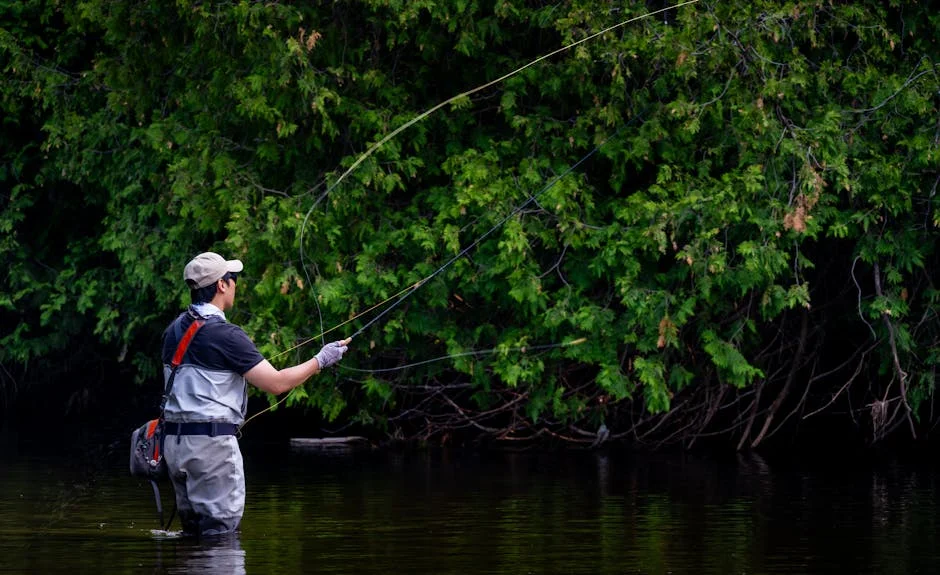
Most people come to fly fishing from spin or bait casting. In those disciplines, you’re launching a weighted lure. The rod flexes, the lure flies, and your mechanics mostly just need to not get in the way. Fly fishing inverts that relationship completely. The fly itself weighs almost nothing. The fly line, which is thick, tapered, and relatively heavy for its length, is what actually travels through the air. Your job is to move that line in a way that carries energy forward cleanly and lays the fly down at the target.
This is why a lot of new fly fishers get into trouble on their first season. They try to muscle the cast, throw harder, or reach for more distance before the basics are solid. The physics don’t reward that approach. Fly casting rewards timing, loop control, and a stopped rod tip. Force matters less than form.
For anyone covering the broader basics of the sport, our Fly Fishing Basics hub is a good place to build context around casting before or after working through rod mechanics specifically.
The Core Mechanics: What Actually Makes a Cast Work
Before picking up a rod, it helps to understand the four mechanical elements that every good fly cast shares.
The Power Stroke and the Stop
The rod does not just wave back and forth. What actually loads the rod blank is a defined acceleration through a short arc, followed by a crisp stop. When the tip stops abruptly, the energy stored in the bent blank transfers into the line, sending it outward in a loop. Without the stop, the tip drifts, the loop opens wide, and the energy dissipates before the line can carry forward.
Think of it like a hammer driving a nail. The speed at impact matters, but the follow-through that stops at the nail is what delivers the force cleanly. Soft or undefined stops are the most common reason casting loops collapse or dump early.
Loop Shape
The loop is the shape the fly line makes in the air between the rod tip and the fly. Tight loops (narrow, roughly parallel top and bottom leg) are efficient, they cut wind and transfer energy well. Wide loops are sloppy and lose energy quickly.
Loop shape is directly controlled by the length of your casting arc and the path your rod tip travels. A short, straight rod tip path makes tight loops. A wide, circular stroke makes wide loops. Most beginners default to wide arcs because it feels like more effort equals more distance. It does not.
Stroke Length vs. Line Length
Beginners cast all their line with the same stroke length, which is part of what causes problems. As you false cast more line out, the stroke needs to lengthen slightly to accommodate. Short line, short stroke. Forty feet of line in the air requires more arc than twenty feet. Failing to match stroke length to line length is why casts fall apart as anglers try to extend reach.
Drift and Haul (When You’re Ready)
The double haul, pulling the fly line with your non-rod hand during both the back cast and forward cast, is an advanced skill that dramatically increases line speed and distance. New casters do not need it yet, and trying to learn it before the basic stroke is solid usually builds bad habits in both hands simultaneously. Single hauls (one pull on the forward cast) can help intermediate casters before the full double haul is introduced.
Common Casting Mistakes (and the Real Fix)
Starting With the Wrong Rod Action
This is the mistake I made myself. Before anyone explained otherwise, I bought a stiff, fast-action blank because I assumed it would help me cast farther. It did the opposite. Fast-action rods require good loop formation to load properly, and I did not have that yet. I spent two seasons fighting the rod instead of learning.
Field reports from newer fly fishers consistently show this same pattern. If you’re just starting, medium-fast or medium-action rods are significantly more forgiving. Fast-action rods reward good casters and punish anglers who haven’t developed timing yet. Save the high-modulus sticks for after the fundamentals are wired in.
The Wrist Flip
Fly casting uses the wrist, but only within a small range. New casters often over-rotate the wrist on the back cast, which throws the rod tip path into a wide arc and opens the loop. The classic teaching fix is to tuck a book or notepad under your casting arm and try to keep it there through the stroke. It limits wrist rotation to the correct range mechanically.
Not Watching the Back Cast
You cannot fix a back cast you can’t see. For the first several practice sessions, turn around and watch your back cast land. Most people discover the loop is falling far too low, usually because the stop is late or soft. Once you see it, the correction becomes intuitive quickly.
Tailing Loops
A tailing loop happens when the bottom leg of the fly line crosses over the top leg, creating a knot (also called a wind knot) in the leader or tippet. It’s caused by applying power too early in the forward stroke, before the back cast has fully straightened. The fix is patience at the transition: wait for the tug, then accelerate.
Tailwater vs. Freestone Casting Considerations
This matters more than most beginners expect. The conditions you’re casting in should shape how you practice and what skills you prioritize first.
On Colorado tailwaters like Cheesman Canyon or Eleven Mile Canyon, you’re often dealing with educated trout in slow, clear water, casting tight to structure with limited back cast room. Accuracy at twenty to forty feet matters far more than distance. Mending line correctly after the cast matters enormously. The cast itself might be modest in distance, but the presentation has to be precise.
On freestone water, like the Arkansas River here near Salida, you’re reading faster current, dealing with more wind, and often covering more water with longer casts to reach fish. Here, line speed and a tighter loop become more useful, and the double haul pays off sooner.
The point is that fly casting is not one skill, it’s a set of situation-specific skills. Getting good at casting on your home water builds one set of reflexes. Moving to different water often reveals gaps you did not know you had.
A Note on Learning Resources
Hiring a casting instructor for even one or two sessions is the fastest way to improve. Certified Casting Instructors (through the Federation of Fly Fishers) will identify specific faults you can’t see yourself. If you’re near a fly shop, ask who teaches locally. At Ark Anglers here in Salida, we point people toward instructors fairly often, because self-taught casting mechanics are hard to unlearn later.
For self-guided learning, some instructional books do the job better than others. The three below are worth noting.
Instructional Books Worth Having
Bert Darrow’s Practical Fly Fishing: How To Cast And Fish Naturally
Bert Darrow’s Practical Fly Fishing: How To Cast And Fish Naturally takes an accessible approach that suits anglers who want casting explained in plain, practical terms rather than technical diagrams. Owner reviews consistently mention that Darrow grounds his instruction in real-fishing scenarios rather than mechanical abstraction, which makes the lessons easier to translate streamside. The book covers not just stroke mechanics but how casting interacts with presentation and fly selection, which is where beginners often need the most context. At a budget price point, it’s a low-risk addition alongside any instructional video series.
Check current price on Amazon.
The Absolute Beginner’s Guide to Fly Fishing
The Absolute Beginner’s Guide to Fly Fishing: Tips, Lessons, and Techniques for Tying Knots, Reading the Water, Casting, and Catching More Fish is a broader introductory text that covers casting within the full context of beginning fly fishing. Verified buyers note the casting section is approachable without oversimplifying, and the book’s scope (knot tying, water reading, tactics) means newer anglers can keep it as a single reference through their first full season. For readers who want to understand how casting fits into the larger picture of the sport, rather than treating it as an isolated skill, this structure is genuinely useful. Budget priced and well-suited to complete beginners.
Check current price on Amazon.
The Orvis Fly-Casting Guide
The Orvis Fly-Casting Guide: How to Cast Effectively in Every Fly-Fishing Situation is the most casting-specific of the three, covering a wide range of situations including wind, tight quarters, specialty casts, and saltwater applications. Owner reviews describe it as the resource they return to when a specific casting problem comes up on the water, rather than a cover-to-cover read. The situational organization is one of its strengths: you can look up reach casts, pile casts, or curve casts by the fishing problem they solve, rather than learning them in isolation. Budget priced and useful well beyond the beginner stage.
Check current price on Amazon.
What to Focus on First: A Practical Sequence
Fly casting instruction can quickly become overwhelming if every technique gets equal priority. It does not. Some things have to come first because later skills build on them.
Week One: The Thirty-Foot Cast
Field reports from certified instructors and verified buyers of beginner texts consistently point to the same starting point: learn to make a clean, consistent cast at thirty feet before worrying about anything else. Pick up line, back cast with a defined stop, wait for the back cast to straighten, forward cast with a defined stop. Repeat. No double haul, no roll cast, no mending. Just that one loop at that one distance until it’s reliable.
Grass is a better practice surface than water early on. You can see the loops, the line does not drag on current, and you can focus entirely on mechanics without also managing a drift.
Week Two Through Month Two: Roll Cast and Mending
The roll cast is the first specialty cast worth learning, and it’s actually used constantly in real fishing. When brush or a bank is behind you and there’s no room for a back cast, the roll cast is what keeps you fishing. It uses surface tension on the water to load the rod, which means it only works on water (or a wet surface), not on grass.
Mending is not technically part of casting mechanics, but it belongs in the same early learning window. A mend is a repositioning of the fly line on the water after the cast lands, used to extend a drag-free drift. On any river with multiple current speeds between you and your fly, you will mend on almost every cast. Learning it early makes every other skill more productive. The Fly Fishing Basics section covers mending and drift management in more detail for anglers building these skills together.
Month Two Through Month Six: Distance, Wind, and Specialty Casts
Once the basic cast and roll cast are consistent, extending distance is the next logical step. This is when the single haul becomes useful. At around forty to fifty feet, wind becomes a real factor, and a tighter loop (driven by better stroke mechanics) matters more. Work on casting into and across wind before learning to cast in still-air conditions only.
Specialty casts like the reach cast, curve cast, and pile cast belong in this window too. Each solves a specific presentation problem that the basic overhead cast cannot. Learning them as you encounter the fishing situations that require them, rather than in the abstract, is usually more effective.
Long-Term: Matching Casting to Reading Water
After the first season, the biggest casting improvement usually comes not from better mechanics but from better water reading. Understanding where fish hold, and why, means shorter casts to better positions, which simplifies the casting demand entirely. A well-placed twenty-five-foot cast beats a sloppy fifty-foot cast almost every time on technical water. Guides who fish rivers like the Missouri or Bighorn professionally make this point constantly: positioning matters more than distance.
Frequently Asked Questions
How long does it take to learn to cast a fly rod?
Most anglers can make a functional, fishable cast within two to four sessions of focused practice. Getting truly consistent, where loops are controlled and the cast holds up under real fishing conditions like wind, moving water, and tight quarters, typically takes a full season. Verified buyers of instructional texts and casting instructors consistently note that one or two guided lessons early on compresses that learning curve significantly by fixing mechanical faults before they become habits.
What rod action is best for beginners learning to cast?
Medium-fast or medium-action rods are the better choice for new casters. Fast-action rods require good loop formation and timing to load properly, and they punish casting errors more harshly. Owner reviews and instructor feedback consistently show beginners progressing faster on more forgiving blanks. Once casting fundamentals are solid, moving to a faster rod is straightforward.
Can I learn to cast a fly rod without a lesson?
Yes, and many anglers do. Instructional books, videos, and focused practice on grass with attention to loop shape will get most people to a functional level. That said, self-taught mechanics often include flaws that are hard to identify without an outside observer. A single lesson with a certified casting instructor is the fastest and cheapest long-term investment in the skill, because unlearning a bad habit after two or three seasons is genuinely harder than building the right habit from the start.
How much line should I have out when learning to cast?
Start with twenty to thirty feet of fly line outside the rod tip. Shorter line is easier to control, loads the rod more predictably, and makes loop problems more visible. Most beginners instinctively want to cast more line than they can manage. Spec data from casting instruction programs shows that clean mechanics learned at shorter distances transfer to longer distances; sloppy mechanics learned at long distances do not clean up easily when you shorten back up.
Do I need to learn the double haul as a beginner?
Not yet. The double haul, pulling the fly line with your non-rod hand during both the back cast and forward cast, adds line speed and is genuinely useful for distance casting and saltwater applications. But it adds a second layer of timing complexity on top of the basic stroke. Field reports from instructors and beginner guides consistently recommend learning a solid single-hand stroke first. Most freshwater trout fishing at normal distances does not require the double haul at all, and chasing it too early splits focus between two unformed skills simultaneously.
<script type="application/ld+json">
{
 "@context": "https://schema.org",
 "@type": "FAQPage",
 "mainEntity": [
 {
 "@type": "Question",
 "name": "How long does it take to learn to cast a fly rod?",
 "acceptedAnswer": {
 "@type": "Answer",
 "text": "Most anglers can make a functional, fishable cast within two to four sessions of focused practice. Getting truly consistent, where loops are controlled and the cast holds up under real fishing conditions like wind, moving water, and tight quarters, typically takes a full season. Verified buyers of instructional texts and casting instructors consistently note that one or two guided lessons early on compresses that learning curve significantly by fixing mechanical faults before they become habits."
 }
 },
 {
 "@type": "Question",
 "name": "What rod action is best for beginners learning to cast?",
 "acceptedAnswer": {
 "@type": "Answer",
 "text": "Medium-fast or medium-action rods are the better choice for new casters. Fast-action rods require good loop formation and timing to load properly, and they punish casting errors more harshly. Owner reviews and instructor feedback consistently show beginners progressing faster on more forgiving blanks. Once casting fundamentals are solid, moving to a faster rod is straightforward. Starting on a fast-action rod before the stroke is developed typically means fighting the equipment rather than learning from it."
 }
 },
 {
 "@type": "Question",
 "name": "Can I learn to cast a fly rod without a lesson?",
 "acceptedAnswer": {
 "@type": "Answer",
 "text": "Yes, and many anglers do. Instructional books, videos, and focused practice on grass with attention to loop shape will get most people to a functional level. That said, self-taught mechanics often include flaws that are hard to identify without an outside observer. A single lesson with a certified casting instructor is the fastest and cheapest long-term investment in the skill, because unlearning a bad habit after two or three seasons is genuinely harder than building the right habit from the start."
 }
 },
 {
 "@type": "Question",
 "name": "How much line should I have out when learning to cast?",
 "acceptedAnswer": {
 "@type": "Answer",
 "text": "Start with twenty to thirty feet of fly line outside the rod tip. Shorter line is easier to control, loads the rod more predictably, and makes loop problems more visible. Most beginners instinctively want to cast more line than they can manage. Spec data from casting instruction programs shows that clean mechanics learned at shorter distances transfer to longer distances; sloppy mechanics learned at long distances do not clean up easily when you shorten back up."
 }
 },
 {
 "@type": "Question",
 "name": "Do I need to learn the double haul as a beginner?",
 "acceptedAnswer": {
 "@type": "Answer",
 "text": "Not yet. The double haul, pulling the fly line with your non-rod hand during both the back cast and forward cast, adds line speed and is genuinely useful for distance casting and saltwater applications. But it adds a second layer of timing complexity on top of the basic stroke. Field reports from instructors and beginner guides consistently recommend learning a solid single-hand stroke first. Most freshwater trout fishing at normal distances does not require the double haul at all, and chasing it too early splits focus between two unformed skills simultaneously."
 }
 }
 ]
}
</script>Where to Buy
Bert Darrow's Practical Fly Fishing: How To Cast And Fish NaturallySee Bert Darrow's Practical Fly Fishing: … on Amazon