Bass on the Fly: An Accessible Guide to Warmwater Fly Fishing

Affiliate disclosure: Some links on this page are affiliate links. If you buy through them we earn a small commission at no extra cost to you. Recommendations are research-driven; we don't claim personal use of every product reviewed. Product prices and availability are accurate as of the date published and are subject to change. Always check Amazon for current pricing before purchasing. Learn more.
Quick Picks
OutdoorFishing Fly Fishing Flies Kit Fly Assortment Trout Bass Fishing with Fly Box, 33/48/72/100/114/148pcs with Dry/Wet Flies, Nymphs, Streamers, Popper
Buy on AmazonFishing for Bass with a Fly: Essential Bass Flies Every Fly Fisherman Should Use To Catch Monster Bass
Buy on Amazon| Product | Price Range | Top Strength | Key Weakness | Buy |
|---|---|---|---|---|
| Best Bass Flies: How to Tie and Fish Them also consider | $$ | Buy on Amazon | ||
| OutdoorFishing Fly Fishing Flies Kit Fly Assortment Trout Bass Fishing with Fly Box, 33/48/72/100/114/148pcs with Dry/Wet Flies, Nymphs, Streamers, Popper also consider | $$ | Buy on Amazon | ||
| Fishing for Bass with a Fly: Essential Bass Flies Every Fly Fisherman Should Use To Catch Monster Bass also consider | $$ | Buy on Amazon |
Bass on the fly is one of the most accessible, genuinely exciting branches of fly fishing that trout anglers overlook. The fish are aggressive, the strikes are violent, and the gear requirements are forgiving compared to the precision tailwater work most of us obsess over.
Worth noting: everything here covers warmwater bass fishing from the bank or wading. I don’t own a boat, and bass-from-a-boat content deserves someone who actually rows it. For the full range of freshwater and saltwater species covered on this site, browse the Species Guides hub.
Why Bass on the Fly Makes Sense for Trout Anglers
Most trout anglers who try bass on the fly for the first time have the same reaction: why did I wait so long? The learning curve is gentler in some ways. Bass are less selective than educated tailwater trout. They won’t refuse your fly because the dubbing color is two shades off. They eat poppers, deer hair frogs, big woolly buggers, and crayfish patterns with the kind of commitment that makes you forget about matching the hatch for an afternoon.
That said, “easier” doesn’t mean “simple.” Bass on the fly has its own set of skills: reading warmwater structure, timing the pause in a popper retrieve, understanding how bass position differently in still water versus moving water. These are disciplines worth taking seriously.
Warmwater Structure Is Different from Trout Water
Trout anglers read current. Bass anglers read structure. The two overlap somewhat on rivers, but on ponds, reservoirs, and lakes, you’re looking at a completely different kind of water reading. Bass hold on edges: weed lines, submerged timber, dock pilings, points where shallow flats drop into deeper water, transitions between hard and soft bottom.
The good news is that bass are not subtle about their preferences. Once you start finding that kind of structure and presenting a fly along the edge of it rather than through it, your catch rate improves quickly. Field reports from warmwater fly anglers consistently point to this as the single biggest adjustment trout fishers need to make.
Gear Considerations for Bass
Trout anglers are often over-gunned or under-gunned for bass. A 5wt rigged with a Rio Gold is a fine tool for dry fly work on the Arkansas, but it’s not ideal for punching a weighted crayfish pattern under a dock overhang or turning over a large deer hair bug in wind.
Most warmwater fly fishers land on a 7wt or 8wt as the bass-specific setup. The heavier line turnover helps with wind resistance on big surface flies. A weight-forward or bass-taper line with a short, aggressive front taper handles the air resistance of poppers and large streamers better than a trout taper. If you’re committed to bass fishing with your existing 5wt or 6wt, stick to smaller flies and accept that casting distance and wind performance will be limited.
For largemouth in heavy cover, owner reports on bass-specific fly setups consistently mention that stiffer rod action helps with hooksets in thick vegetation. Fluorocarbon leaders in the 8 to 12-pound range are standard, with heavier tippet used near structure where fish will try to bury themselves immediately after the strike.
The Strip-Set and Why It Matters
This is the adjustment that trips up trout anglers most consistently. In trout fishing, the instinct is to lift the rod tip on the strike. That reflex will cost you bass.
Bass fishing with a fly, especially on streamers and poppers, demands a strip-set: you drive the hook home by stripping line hard with your line hand, keeping the rod low and pointed at the fish. Lifting the rod on a bass strike typically pulls the fly away before the hook penetrates. I learned this the difficult way on bonefish in Belize in 2014. I couldn’t strip-set reliably in a real fishing situation despite practicing it on the lawn, and I spooked or missed almost everything I saw that trip. The muscle memory takes deliberate practice to override, and warmwater fishing is actually a good place to build it before a saltwater trip.
Understanding Bass Fly Categories
Bass flies break down into a few functional categories. Understanding what each one does helps you make decisions on the water rather than randomly cycling through a box.
Surface flies include hard-body poppers, foam poppers, deer hair bugs, and gurglers. These are the reason many anglers fall in love with bass on the fly. The visual strike is addictive. Early morning and evening, low light, overcast days, and calm water surfaces are prime conditions for topwater.
Subsurface flies cover a wide range: woolly buggers, Clouser minnows, Deceiver-style baitfish patterns, crayfish imitations, and leech patterns. These produce fish throughout the day, especially when surface action slows in bright midday conditions.
Weedless patterns are a separate consideration for heavily vegetated water. Bass will hold in lily pads, hydrilla, and emergent vegetation where a non-weedless fly gets destroyed on every cast. Weedless deer hair frogs, weedguard-equipped Clousers, and similar designs open up water that would otherwise be unfishable.
Top Picks for Bass on the Fly
Best Bass Flies: How to Tie and Fish Them
Best Bass Flies: How to Tie and Fish Them is a mid-range reference book that covers both the tying instruction and the fishing application for the most productive bass patterns in use today. Based on owner reviews, the book does a solid job of connecting pattern design to function, explaining why a specific fly works on a particular type of bass water rather than just listing recipes.
Verified buyers note that the photography and step-by-step tying sequences are clear enough for intermediate tiers to follow without frustration. The fishing chapters cover retrieve styles, structure targeting, and seasonal considerations, which makes this useful beyond the vise. If you tie your own flies, this is a more valuable resource than a pre-tied kit because it builds the understanding behind the patterns.
Readers who already have significant tying experience report that they found the fishing application sections worth the purchase even if the tying content was familiar. The pattern selection skews toward proven fish-catchers rather than novelty flies, which is the right editorial choice for a reference like this.
Check current price on Amazon.
OutdoorFishing Fly Fishing Flies Kit
The OutdoorFishing Fly Fishing Flies Kit is a mid-range assortment that covers a wide range of pattern types: dry flies, wet flies, nymphs, streamers, and poppers, packaged with a fly box in configurations ranging from 33 to 148 pieces. For bass specifically, the popper and streamer components of the kit are the relevant section.
Owner reviews indicate that the kit functions well as a starting point for anglers who want to experiment with bass on the fly before committing to building a dedicated warmwater box. Verified buyers note that fly quality is consistent for the price band, though some patterns are lighter on materials compared to boutique-tied alternatives. The included fly box is reported to be functional, if not durable over multiple seasons of hard use.
For trout anglers who already have a well-stocked dry fly and nymph collection, the practical value here is in the bass-specific surface and streamer patterns rather than the full kit. Spec data shows the larger kit sizes (100-plus pieces) provide enough variety to cover most warmwater situations without needing immediate supplementation.
Check current price on Amazon.
Fishing for Bass with a Fly: Essential Bass Flies Every Fly Fisherman Should Use To Catch Monster Bass
Fishing for Bass with a Fly is a mid-range digital reference targeted at fly anglers who want a concise, practical entry point into warmwater bass fishing. Field reports from buyers describe it as a quick-read format that prioritizes actionable information over comprehensive coverage, which suits the angler who wants to get on the water rather than work through a dense reference volume.
Verified buyers note that the pattern selection focuses on high-percentage producers, which is useful for someone building a bass box from scratch. The fishing application content covers basic retrieve techniques and structure-oriented presentation approaches that align with what experienced warmwater guides teach in person. The format works well for anglers already comfortable with fly fishing fundamentals who just need the warmwater translation.
Readers looking for deep tying instruction will find this less satisfying than a full tying manual. The value is in the “what to fish, where, and how” framing rather than pattern construction detail.
Check current price on Amazon.
Bass on the Fly: A Buying Guide
Rod and Line Selection
Bass fly fishing works best on rods in the 7wt to 9wt range. The 7wt is the most versatile: capable of turning over large poppers, handling wind, and fighting largemouth in moderate cover. Step up to an 8wt or 9wt for heavy timber, big streamers, or smallmouth in fast river current where fish have current assistance on their side.
Rod action for bass skews medium-fast to fast. You need enough tip sensitivity to feel the pause in a retrieve but enough backbone to drive hooks into the hard mouths of bass and control fish near structure. Owner reports on bass-specific rods consistently favor moderate-fast blanks over ultra-fast trout rods for this application.
Line and Leader Setup
Bass-taper fly lines with short, aggressive front tapers handle the air resistance of poppers and large deer hair bugs far better than trout tapers. The mass of a bass fly requires a line that delivers energy quickly. Scientific Anglers and Rio both produce warmwater-specific tapers worth considering if you’re rigging a dedicated bass outfit.
Leaders for bass are shorter and heavier than trout setups. A 7.5-foot leader tapered to 10 or 12-pound fluorocarbon covers most situations. Near heavy cover, some anglers fish 15 to 20-pound straight fluorocarbon on a short, 5-foot leader. Subtlety matters less; control and abrasion resistance matter more.
Fly Selection by Water Type
Bass fly selection changes with water type, which is a principle worth internalizing from other species in our Species Guides coverage. On still water with clear visibility and weed structure, surface flies and weedless presentations dominate. On rivers and streams with current, crayfish patterns, woolly buggers, and Clouser minnows fished along banks and structure edges are more consistently productive.
Seasonal timing matters too. Early season and fall, when bass are aggressive and shallow, favor surface presentations. Midsummer heat pushes fish deeper, and subsurface patterns fished slower with longer pauses produce better. Field reports from warmwater guides consistently describe this as the most important seasonal adjustment for trout anglers making the switch.
Building a Starting Bass Fly Box
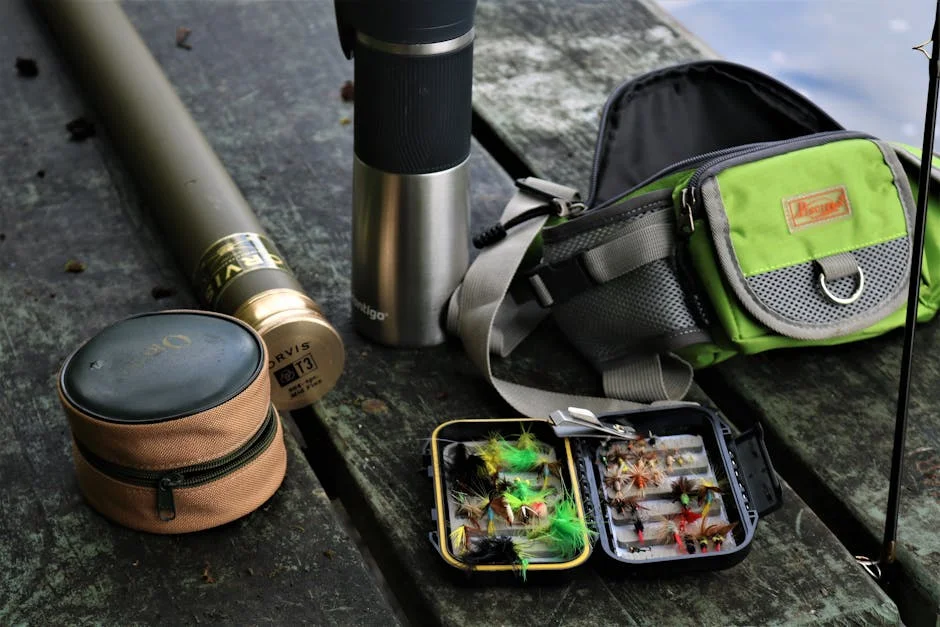
A functional starting bass box doesn’t require 200 flies. Verified buyer reports and guide recommendations consistently converge on a core set: a few surface poppers in white and chartreuse, a deer hair bug or foam frog for weed cover, Clouser minnows in white and olive, a crayfish pattern, and a couple of large woolly buggers in black and olive.
That core covers still water and moving water, surface and subsurface, clear and stained conditions. Once you’ve fished those patterns enough to understand when each one works and why, expanding the box becomes an informed decision rather than random accumulation. Books like the ones covered in the Top Picks section above help accelerate that learning curve.
Smallmouth vs. Largemouth Fly Selection
These are different fish with meaningfully different habitat preferences, and gear choices shift accordingly. Largemouth bass favor slower, heavily vegetated water. Weedless presentations, surface flies, and slow retrieves near cover are the core largemouth approach. Smallmouth hold in current, on rocky substrate, and in clear, fast-moving rivers where presentation accuracy and fly control in current matter more.
Smallmouth respond aggressively to crayfish patterns and streamers fished with active retrieves. Poppers work well on smallmouth in low light, but the real smallmouth action often comes subsurface. The Arkansas River, where I fish most often, holds good smallmouth, and the approach feels closer to streamer fishing for brown trout than classic largemouth pond work.
Closing Thoughts
Bass on the fly rewards anglers who respect the learning curve while staying willing to fish aggressively. The flies are bigger, the takes are violent, and the gear is more forgiving than most trout setups. If you’ve been a trout-only angler and haven’t put in time on warmwater fish, the adjustment is real but the payoff is worth it.
For more species-specific coverage across freshwater and saltwater, the Species Guides hub is the central resource on this site. Bass fishing is a good entry point into warmwater fly fishing, and the skills you build there, especially the strip-set and structure reading, carry forward into most of the warmwater and saltwater work that comes next.
Frequently Asked Questions
What weight fly rod should I use for bass on the fly?
Most bass fly anglers land on a 7wt as the most versatile option. It handles large poppers, turns over deer hair bugs in wind, and has enough power to control fish near heavy cover. An 8wt or 9wt makes sense for fishing big streamers, heavy timber, or situations where you need maximum stopping power. A 5wt or 6wt will work for smaller flies and open water, but casting performance with large bass flies drops off noticeably.
Can I use my trout fly rod for bass fishing?
A 5wt or 6wt trout rod will catch bass, but casting large poppers and deer hair bugs with a light trout taper is frustrating. The flies are wind-resistant and heavy, and trout tapers aren’t designed to turn them over efficiently. For occasional bass fishing with smaller flies in calm conditions, your trout outfit is serviceable. For serious bass work, a heavier rod with a bass-taper line produces a noticeably better casting experience and more consistent presentations.
What are the best flies for largemouth bass on the fly?
Surface poppers, deer hair bugs, weedless frog patterns, Clouser minnows, and large crayfish imitations cover most largemouth situations. Early morning and evening favor topwater presentations, particularly near weed edges and dock structure. Midday and bright-sun conditions typically call for subsurface flies fished deeper and slower. A small box built around those categories handles the majority of warmwater largemouth situations you’ll encounter.
Is bass fly fishing good for beginners to fly fishing?
Bass fly fishing can be a productive entry point for new fly anglers, particularly because bass are less selective than educated trout. The strip-set retrieve takes practice to override trout instincts, but the fish are forgiving of imperfect presentation. Still-water bass on poppers is one of the more accessible fly fishing experiences available. That said, casting a heavy bass outfit with large flies requires solid basic mechanics, so foundational casting practice is still important before heading out.
What’s the difference between largemouth and smallmouth bass on the fly?
Largemouth prefer slow, weedy, still-water environments where weedless surface flies and slow retrieves near structure produce best. Smallmouth hold in current, rocky rivers, and clearer, faster water where crayfish patterns, streamers, and active retrieves are more effective. The gear overlap is significant, but smallmouth fishing on rivers reads more like trout fishing in terms of current positioning and presentation. Many trout anglers find smallmouth in rivers a natural bridge species between the two disciplines.
Where to Buy
Best Bass Flies: How to Tie and Fish ThemSee Best Bass Flies: How to Tie and Fish … on Amazon