What Is a Tapered Leader in Fly Fishing

Affiliate disclosure: Some links on this page are affiliate links. If you buy through them we earn a small commission at no extra cost to you. Recommendations are research-driven; we don't claim personal use of every product reviewed. Product prices and availability are accurate as of the date published and are subject to change. Always check Amazon for current pricing before purchasing. Learn more.
Quick Picks
SF Pre-Tied Loop Fly Fishing Tapered Leader Nylon Clear Trout Freshwater Saltwater Bonefish Permit Bass Salmon Steelhead 7.5FT 9FT 10FT 12FT 15FT 0X 1X 2X 3X 4X 5X 6X 7X
Buy on AmazonPiscifun Fly Fishing Leader with Pre-Tied Loop, Tapered Fly Line Leader, Nylon, Clear, 6 Pack, 7.5FT, 9FT, 12FT, 0X 1X 2X 3X 4X 5X 6X 7X
Buy on AmazonSF 3 Packs Pre-Tied Loop Fly Fishing Tapered Leader Fluorocarbon 7.5FT 9FT 12FT 0X 1X 2X 3X 4X 5X 6X 7X
Buy on Amazon| Product | Price Range | Top Strength | Key Weakness | Buy |
|---|---|---|---|---|
| SF Pre-Tied Loop Fly Fishing Tapered Leader Nylon Clear Trout Freshwater Saltwater Bonefish Permit Bass Salmon Steelhead 7.5FT 9FT 10FT 12FT 15FT 0X 1X 2X 3X 4X 5X 6X 7X also consider | $ | Buy on Amazon | ||
| Piscifun Fly Fishing Leader with Pre-Tied Loop, Tapered Fly Line Leader, Nylon, Clear, 6 Pack, 7.5FT, 9FT, 12FT, 0X 1X 2X 3X 4X 5X 6X 7X also consider | $ | Buy on Amazon | ||
| SF 3 Packs Pre-Tied Loop Fly Fishing Tapered Leader Fluorocarbon 7.5FT 9FT 12FT 0X 1X 2X 3X 4X 5X 6X 7X also consider | $ | Buy on Amazon |
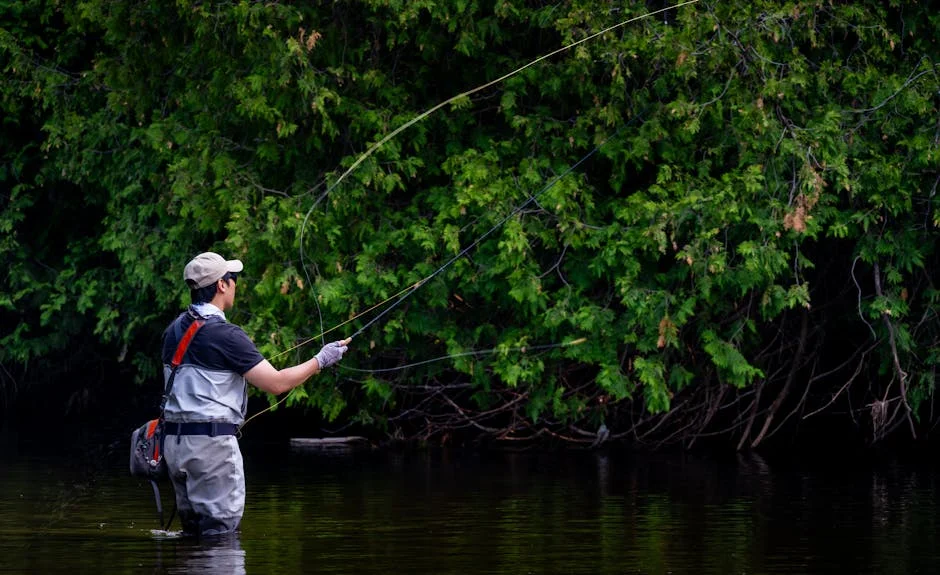
If you’ve ever watched a fly land delicately on the surface while the thick fly line stays well upstream, you were watching a tapered leader do exactly what it’s designed to do. That transition piece between your fly line and your fly is doing more mechanical work than most new anglers realize.
Understanding what a tapered leader is, why the taper matters, and how to choose the right one for your fishing situation is foundational. It belongs in the same category as understanding fly line weight or hook sizing. If you’re new to the sport, the Fly Fishing Basics hub is a good place to build context around this topic.
What Is a Tapered Leader, Exactly?
A tapered leader is a length of monofilament or fluorocarbon that connects your fly line to your tippet (or directly to your fly). The key word is “tapered,” meaning the leader starts thicker at the fly line end and gradually steps down to a thinner diameter at the tippet end.
That taper is not decorative. It’s functional physics.
When you cast a fly line, energy travels down the line in a rolling loop. A level (non-tapered) piece of monofilament would cause that energy to stop abruptly at the connection point, producing a pile of leader at the end of your cast. A properly tapered leader allows that energy to transfer progressively through the thicker “butt” section, through the mid-section, and out through the fine tip, laying the fly down with control.
Frank at Ark Anglers explained it to me early on with a good analogy: think of it like a whip. A whip is thick at the handle and thin at the tip. The energy transfers through the taper and releases efficiently at the end. A tapered leader works on the same principle.
The Three Sections of a Tapered Leader
Most tapered leaders have three distinct zones:
The butt section makes up roughly 60 percent of the total length. This is the heaviest diameter section, generally 0.019 to 0.025 inches, depending on the leader’s overall design. It connects to your fly line (via a loop-to-loop connection on most modern leaders) and carries the casting energy forward.
The mid-section or taper transitions the diameter downward in a series of steps or a gradual taper. This is where the energy conversion happens. Longer, more gradual tapers transfer energy more gently, which tends to produce softer presentations. Shorter, more aggressive tapers transfer energy more forcefully, which can help with accuracy in wind but can slap dry flies onto the surface if you’re not careful.
The tippet section is the finest part at the terminal end, rated by an “X” designation (explained below). Most manufacturers keep this section relatively short, with the expectation that you’ll attach additional tippet material as needed.
Understanding the X-Rating System
The X-designation on leader packaging is a diameter measurement. The formula is simple enough that a mechanical engineer appreciates it: subtract the X number from 11, and you get the diameter in thousandths of an inch. So 5X equals 0.006 inches (11 minus 5), and 0X equals 0.011 inches (11 minus 0).
Here’s a practical reference:
| X Rating | Diameter (inches) | Typical Use | |, |, |, | | 0X | 0.011 | Streamers, large bass/steelhead flies | | 1X | 0.010 | Large nymphs, streamers | | 2X | 0.009 | Larger dry flies, nymphs | | 3X | 0.008 | Medium dry flies, nymphs | | 4X | 0.007 | Standard trout dry flies | | 5X | 0.006 | Small dry flies, midges | | 6X | 0.005 | Tiny midges, technical tailwater fishing | | 7X | 0.004 | Extreme technical fishing, very small flies |
On the South Platte tailwaters at Cheesman Canyon, I’m fishing 6X and sometimes 7X tippet with size 22 to 26 midges. On the Arkansas River in the canyon above Salida, I’m typically running 4X or 5X with bigger attractor patterns and heavier nymphs. The water type dictates the choice almost every time.
Knotted vs. Knotless Tapered Leaders
Two construction methods exist, and they matter to understand even if most modern pre-made leaders are knotless.
Knotless leaders are extruded in a single continuous piece with a built-in taper. The diameter change is smooth and gradual. These are easier to use, less likely to pick up algae or debris at knot points, and produce a cleaner energy transfer for dry fly presentations. The majority of commercially available leaders today are knotless.
Knotted leaders are assembled from individual sections of monofilament in descending diameters, connected with blood knots or surgeon’s knots. The energy transfer at each knot junction creates a slightly more abrupt step-down. Knotted leaders were the original method before extrusion technology made knotless construction practical. Some serious dry fly anglers still build custom knotted leaders because you can dial in exactly the butt-to-taper ratio you want for a specific presentation.
For most trout fishing situations, a well-designed knotless leader performs excellently. Knotted leaders are worth understanding as a concept, but not something you need to build yourself when you’re starting out.
Nylon vs. Fluorocarbon Leaders
This is a choice that comes up constantly, and the answer genuinely depends on how and where you’re fishing.
Nylon monofilament has been the standard material for tapered leaders for decades. It’s softer, more supple, and has more natural stretch than fluorocarbon. That stretch acts as a slight shock absorber on the hook set, which can be advantageous with fine tippets. Nylon also floats more readily, which matters for dry fly presentations. Verified buyers of nylon leaders consistently note good overall presentation quality for general trout fishing.
Fluorocarbon has a refractive index close to water (approximately 1.42 versus water’s 1.33), meaning it’s less visible underwater than nylon. It’s denser than nylon, so it sinks faster, which can help with subsurface presentations. Fluorocarbon is also more abrasion-resistant, which matters on rocky freestone streams. The tradeoff is stiffness. Fluorocarbon leaders and tippet tend to be stiffer, which can affect presentation on delicate dry fly work.
My general approach, based on years of fishing Colorado tailwaters and freestone: nylon leaders for dry fly fishing, fluorocarbon for subsurface nymphing and streamers. That’s a simplification, but it holds up most of the time.
Leader Length: Why It Matters
Standard tapered leaders come in 7.5-foot, 9-foot, 10-foot, 12-foot, and 15-foot lengths. The choice isn’t arbitrary.
Shorter leaders (7.5 ft) are easier to turn over in wind, work well for streamers and larger flies, and simplify casting for beginners. If you’re throwing a size 4 articulated streamer on your Scott Centric in a Bighorn side channel with a 20 mph headwind, a shorter leader is a practical choice.
9-foot leaders are the all-around standard for trout fishing. The vast majority of trout anglers spend most of their time with a 9-foot leader. It’s long enough for reasonable drag-free drifts on medium-sized water and short enough to be manageable.
Longer leaders (12 to 15 ft) are valuable for technical tailwater fishing where fish are spooky and you need more distance between your fly line and your fly. On pressured water like Cheesman Canyon on a clear-sky day with low flows, a 12-foot leader with an additional 18 to 24 inches of 6X tippet is often necessary to get any cooperation from the fish.
One note on longer leaders: they’re harder to cast. A 15-foot leader requires solid loop control to turn over properly. This is where I’d echo something I learned the hard way with rod selection early on in my fishing life. I bought a stiff fast-action rod thinking it would help me cast farther, and it did the opposite because I didn’t yet have the loop formation skills that rod demanded. The same principle applies to long leaders. Don’t jump to a 15-footer until you can consistently turn over a 9-footer cleanly.
Buying Guide: Choosing the Right Tapered Leader
This section is for anglers who’ve read the explanation above and want to translate that into an actual purchase decision. More foundational gear context lives in the fly fishing basics resources at /learn/.
Match Leader Length to Your Water Type
Shorter leaders work on tight, brush-lined small streams where you’re making 20-foot presentations to close-in fish. Longer leaders are built for open water where visibility and drag are the main problems. A 9-foot leader covers a wide range of scenarios and is the right default for most trout anglers starting out. If you fish Colorado tailwaters or any heavily pressured trout water, add a 12-foot option to your kit. Buy one of each to start and you’ll figure out quickly which situations call for which length.
Choose X-Rating Based on Your Fly Size
The general rule is to divide your hook size by 3 to get the appropriate X rating. A size 16 fly calls for roughly 5X tippet (16 divided by 3 equals 5.3). This isn’t an engineering formula, it’s a rough guide. Fly size 18 to 22 on a technical tailwater usually means 6X. Larger attractor patterns, size 10 to 14, often run well on 4X. The practical consequence of going too light is break-offs on hook sets. Going too heavy produces drag-free drift problems because the heavier tippet influences how the fly moves in current. Field reports from trout anglers across Colorado and Wyoming tailwaters generally confirm this size-to-X matching approach.
Nylon for Dry Flies, Fluorocarbon for Below the Surface
This is worth repeating as a buying filter because it directly affects which pre-made leader you grab at the shop. If you’re buying a single leader to try out this season and you fish mostly dry flies, buy nylon. If you’re primarily nymphing or throwing streamers, fluorocarbon deserves a look. Owner reviews for fluorocarbon leaders consistently highlight better performance in clear, low water conditions where fish are examining the tippet. Budget-friendly multi-pack options in both materials make it practical to carry both types without significant investment.
Pre-Tied Loop vs. Knotless Loop Connection
Most modern pre-made tapered leaders come with a pre-tied perfection loop at the butt end, which allows a loop-to-loop connection directly to your fly line. This is extremely convenient and holds well when properly connected. Spec data on standard perfection loops shows they retain approximately 85 to 90 percent of the monofilament’s rated breaking strength when tied correctly. Non-looped leaders require a nail knot or similar connection to the fly line, which takes more time on the water. For most anglers, the pre-tied loop option is the practical choice, and nearly all budget and mid-range leaders now include it.
Multi-Pack Value and When to Stock Up
Leaders are consumable items. You’ll lose them to trees, rocks, and the occasional fish that finds a sharp edge. Buying leaders in multi-packs rather than individually makes practical sense, especially if you’ve identified a specific length and X-rating combination that works for your home water. Budget-tier multi-packs represent solid value for stocking a leader wallet at the start of each season. Field reports from community fishing forums and verified buyer reviews consistently note that budget nylon and fluorocarbon leaders in multi-pack formats perform well relative to their price point for average trout fishing conditions.
Top Picks
The three options below represent accessible, budget-friendly choices that illustrate the variety of configurations available in pre-made tapered leaders. These are referenced here because they cover the range of materials, sizes, and pack configurations that the sections above discuss.
SF Pre-Tied Loop Fly Fishing Tapered Leader Nylon Clear
The SF Pre-Tied Loop Fly Fishing Tapered Leader Nylon Clear is a nylon monofilament option available in a broad range of lengths (7.5, 9, 10, 12, and 15 feet) and X ratings from 0X through 7X. That range makes it a useful illustrative example of how leaders are sized across different applications. The 7.5-foot option covers the short-leader streamer scenarios discussed above, while the 15-foot option represents the long-leader tailwater configuration. Owner reviews note generally good turnover quality for standard trout applications and consistent loop quality at the butt end. Spec data lists the material as clear nylon, which performs as expected for dry fly and general trout applications. Verified buyers across the freshwater trout category report reliable performance for general use, which matches what you’d expect from a budget-tier knotless nylon leader.
Check current price on Amazon.
Piscifun Fly Fishing Leader with Pre-Tied Loop
The Piscifun Fly Fishing Leader with Pre-Tied Loop comes in a 6-pack configuration, covering lengths of 7.5, 9, and 12 feet with X ratings from 0X through 7X. The 6-pack format directly addresses the consumable nature of leaders discussed in the buying guide. Stocking up at the start of a season is a practical approach, and a multi-pack at a budget price point makes that feasible. Verified buyers note that the nylon material turns over cleanly for standard trout fishing at the lengths listed, and the pre-tied loop holds consistently through normal use. Field reports from community forums indicate this is a commonly recommended entry-level leader for anglers building out their first leader and tippet kit.
Check current price on Amazon.
SF 3 Packs Pre-Tied Loop Fly Fishing Tapered Leader Fluorocarbon
The SF 3 Packs Pre-Tied Loop Fly Fishing Tapered Leader Fluorocarbon brings the fluorocarbon material option into the budget tier, available in 7.5, 9, and 12-foot lengths and X ratings from 0X through 7X. As discussed in the nylon vs. fluorocarbon section, fluorocarbon is the better choice for subsurface presentations and clear, low-water conditions. The 3-pack format mirrors the multi-pack value proposition of the Piscifun option above. Owner reviews on this product specifically reference the low-visibility qualities performing as expected in clear tailwater conditions, which aligns with the material science behind fluorocarbon’s refractive index. Verified buyers note slightly stiffer feel compared to nylon, consistent with the material properties described earlier.
Check current price on Amazon.
Putting It Together
The tapered leader is genuinely one of the more thoughtfully engineered pieces of your fly fishing setup, even if it’s inexpensive and easy to overlook. The taper geometry, material choice, and X rating are all doing specific physical work to get your fly where it needs to be in a way that doesn’t spook fish.
After twenty years, the leader selection decisions that once felt complicated have become mostly automatic. But I still get it wrong occasionally on new water or unfamiliar conditions, and that’s a good reminder that the fundamentals stay relevant. If you’re still building out your understanding of how all this gear fits together, the Fly Fishing Basics resources at /learn/ cover the adjacent topics like fly line weight, tippet selection, and knot basics in the same practical terms.
Get a 9-foot leader in the X rating appropriate for your target flies, start fishing, and adjust from there.
Frequently Asked Questions
What is the difference between a tapered leader and regular monofilament?
Regular monofilament is a level line, meaning it has the same diameter from end to end. A tapered leader starts thick at the fly line end and steps down to a finer diameter at the tippet end. That taper allows casting energy to transfer progressively through the leader, laying the fly down with control. A level piece of mono would pile up at the end of your cast and make accurate, drag-free presentations nearly impossible.
How long should my tapered leader be for trout fishing?
A 9-foot leader is the practical standard for most trout fishing situations and covers the majority of scenarios on medium-sized water. Shorter 7.5-foot leaders work better for streamers and windy conditions. Longer 12 to 15-foot leaders are useful on pressured tailwaters where spooky fish require more distance between fly line and fly. Start with 9 feet and move longer or shorter based on your specific water conditions.
Should I use nylon or fluorocarbon tapered leaders?
Nylon is softer, more supple, floats better, and is generally the better choice for dry fly fishing. Fluorocarbon is denser, sinks faster, has a lower refractive index making it less visible underwater, and is more abrasion-resistant. Choose nylon for surface presentations and fluorocarbon for nymphing and streamers. Both materials are available at budget price points in multi-pack formats, making it practical to carry both.
What X rating should I start with?
For general trout fishing with standard dry flies and nymphs in the size 12 to 16 range, a 4X or 5X leader covers most situations. Smaller flies in the size 18 to 26 range call for 6X or 7X. Larger streamers and heavier nymphs work well on 1X to 3X. Dividing your hook size by 3 gives you a rough starting X rating.
Do I need to add tippet to a tapered leader?
Yes, and you should expect to do this regularly. The tippet section of a pre-made leader is intentionally short. Each time you change flies, you lose a little length from the tippet end. Adding a length of tippet material in the appropriate X rating extends the useful life of the leader significantly and maintains the fine-diameter terminal end that the taper is designed to deliver. A standard practice is to add 18 to 24 inches of tippet material before fishing and replace it as needed throughout the day.
<script type="application/ld+json">
{
 "@context": "https://schema.org",
 "@type": "FAQPage",
 "mainEntity": [
 {
 "@type": "Question",
 "name": "What is the difference between a tapered leader and regular monofilament?",
 "acceptedAnswer": {
 "@type": "Answer",
 "text": "Regular monofilament is a level line, meaning it has the same diameter from end to end. A tapered leader starts thick at the fly line end and steps down to a finer diameter at the tippet end. That taper allows casting energy to transfer progressively through the leader, laying the fly down with control. A level piece of mono would pile up at the end of your cast and make accurate, drag-free presentations nearly impossible."
 }
 },
 {
 "@type": "Question",
 "name": "How long should my tapered leader be for trout fishing?",
 "acceptedAnswer": {
 "@type": "Answer",
 "text": "A 9-foot leader is the practical standard for most trout fishing situations and covers the majority of scenarios on medium-sized water. Shorter 7.5-foot leaders work better for streamers and windy conditions. Longer 12 to 15-foot leaders are useful on pressured tailwaters where spooky fish require more distance between fly line and fly. Start with 9 feet and move longer or shorter based on your specific water conditions."
 }
 },
 {
 "@type": "Question",
 "name": "Should I use nylon or fluorocarbon tapered leaders?",
 "acceptedAnswer": {
 "@type": "Answer",
 "text": "Nylon is softer, more supple, floats better, and is generally the better choice for dry fly fishing. Fluorocarbon is denser, sinks faster, has a lower refractive index making it less visible underwater, and is more abrasion-resistant. Choose nylon for surface presentations and fluorocarbon for nymphing and streamers. Both materials are available at budget price points in multi-pack formats, making it practical to carry both."
 }
 },
 {
 "@type": "Question",
 "name": "What X rating should I start with?",
 "acceptedAnswer": {
 "@type": "Answer",
 "text": "For general trout fishing with standard dry flies and nymphs in the size 12 to 16 range, a 4X or 5X leader covers most situations. Smaller flies in the size 18 to 26 range call for 6X or 7X. Larger streamers and heavier nymphs work well on 1X to 3X. Dividing your hook size by 3 gives you a rough starting X rating. Adjust based on water clarity and fish behavior."
 }
 },
 {
 "@type": "Question",
 "name": "Do I need to add tippet to a tapered leader?",
 "acceptedAnswer": {
 "@type": "Answer",
 "text": "Yes, and you should expect to do this regularly. The tippet section of a pre-made leader is intentionally short. Each time you change flies, you lose a little length from the tippet end. Adding a length of tippet material in the appropriate X rating extends the useful life of the leader significantly and maintains the fine-diameter terminal end that the taper is designed to deliver. A standard practice is to add 18 to 24 inches of tippet material before fishing and replace it as needed throughout the day."
 }
 }
 ]
}
</script>Where to Buy
SF Pre-Tied Loop Fly Fishing Tapered Leader Nylon Clear Trout Freshwater Saltwater Bonefish Permit Bass Salmon Steelhead 7.5FT 9FT 10FT 12FT 15FT 0X 1X 2X 3X 4X 5X 6X 7XSee SF Pre-Tied Loop Fly Fishing Tapered … on Amazon